
The search term training llblogkids currently points mainly toward parenting and child-development content associated with the LLBlogKids website. LLBlogKids describes itself as a resource for parents, caregivers, and educators, covering child training, learning, play, discipline, and everyday development.
One important point is worth making at the beginning: there is no clear evidence that “training LLBlogKids” is the name of a formally validated child-development program or a recognized clinical parenting method. Current search results largely use the phrase as a topic or keyword for guides about raising children. The most direct LLBlogKids article presents child training as teaching habits, responsibility, communication, emotional skills, and positive behavior rather than controlling children through fear.
That distinction matters. Parents looking for meaningful training strategies are better served by evidence-based positive parenting principles than by treating a website’s terminology as an established professional framework.
What Training LLBlogKids Means
In practical terms, training LLBlogKids can be understood as a search-oriented label for teaching children useful skills and behaviors through guidance, practice, routines, encouragement, and age-appropriate expectations.
The LLBlogKids guide emphasizes several familiar areas of child development, including communication, independence, emotional intelligence, responsibility, problem-solving, manners, reading, healthy habits, and digital behavior.
That broad interpretation aligns with guidance from the CDC, which describes parenting as nurturing, protecting, and guiding children while helping them develop toward independence. The CDC also organizes positive parenting advice by developmental stage because what works for an infant is not necessarily appropriate for a school-age child.
So, rather than thinking of training as making a child obey every instruction, it is more useful to think of it as teaching a child how to function confidently and responsibly.
Why Positive Training Matters
Children do not automatically know how to manage frustration, communicate clearly, wait their turn, solve disagreements, or organize responsibilities. These abilities develop through relationships, observation, practice, and repeated guidance.
Positive parenting puts the relationship at the center of that process. UNICEF’s current parenting guidance describes positive parenting as building a strong bond, guiding behavior with kindness, and setting clear, age-appropriate boundaries.
The American Academy of Pediatrics similarly recommends discipline that teaches acceptable behavior rather than focusing mainly on punishment. Its guidance emphasizes clear limits, calm communication, modeling appropriate behavior, and consistent responses.
This creates an important difference between discipline and punishment. Discipline should answer the question, “What should the child learn from this situation?” Punishment that relies on fear or humiliation often focuses only on stopping behavior in the moment.
Start With Age-Appropriate Expectations
A common mistake in child training is expecting a young child to behave like an older child.
Development happens in stages. The CDC notes that infants, toddlers, preschoolers, and older children have different developmental abilities and needs.
For toddlers, training might involve following simple instructions, learning basic manners, putting toys away, and beginning to recognize emotions. For preschoolers, parents can introduce simple routines, turn-taking, listening, and small responsibilities. School-age children can gradually handle homework routines, household tasks, time management, teamwork, and more independent decision-making.
The exact pace will differ from one child to another. UNICEF also stresses that children have their own personalities, needs, and developmental paths, making comparison a poor substitute for understanding the individual child.
The goal is not to make every child reach the same behavior at exactly the same time. The goal is to give each child an appropriate opportunity to practice.
Build Routines Instead of Constantly Giving Orders
Children generally benefit from predictable routines because routines make expectations easier to understand.
A practical day might include regular times for waking, meals, school preparation, homework, play, family interaction, reading, and sleep. The original LLBlogKids guide also recommends consistent daily routines and describes predictable schedules as helpful for reducing stress and making expectations clearer.
A routine works better when children understand it rather than simply being commanded through it.
For example, “It is bedtime, so we are putting the toys away, brushing teeth, reading, and getting into bed” gives a child a sequence. A sudden command such as “Go to bed now” offers much less structure.
Visual schedules can also help younger children understand what comes next.
Use Positive Discipline
One of the strongest themes across the LLBlogKids search results is positive discipline. The site’s training guide recommends calmly explaining inappropriate behavior, using reasonable consequences, and helping children understand better choices.
That approach is consistent with major child-development organizations.
The AAP states that spanking, slapping, yelling, and shaming are ineffective approaches to correcting behavior and can have harmful consequences. UNICEF likewise advises parents to avoid violence and threats and instead use calm guidance, clear boundaries, and consistent consequences.
A simple pattern can help:
Name the behavior, explain why it is a problem, state the boundary, and describe the reasonable consequence.
For example, instead of labeling a child as “bad,” a parent can focus on what happened: “Hitting hurts people. We do not hit. Let’s take a break and find another way to handle this.”
The correction is firm without attacking the child’s identity.
Teach Responsibility Through Real Tasks
Responsibility becomes meaningful when children actually get opportunities to practice it.
The LLBlogKids guide suggests age-appropriate activities such as putting toys away, helping set the table, organizing a school bag, folding clothes, and helping with simple meal preparation.
UNICEF similarly emphasizes learning through participation in everyday family life. Children can develop skills, confidence, and belonging by joining ordinary household activities, even when the work takes longer than it would if an adult completed it alone.
Parents do not need to create elaborate training exercises. Everyday life already offers plenty of opportunities.
A child can learn responsibility by putting books on a shelf, feeding a pet with supervision, carrying appropriate school items, helping clean up after an activity, or choosing between two suitable options.
The important part is allowing the child to participate rather than doing everything for them.
Help Children Understand Their Emotions
Behavior is often connected to emotions that children have not yet learned to manage.
Young children may cry, shout, withdraw, or have tantrums because they lack the communication and self-regulation skills needed to explain what they feel. UNICEF’s current guidance notes that toddlers can struggle to express feelings and that tantrums can occur when children become overwhelmed by emotions.
Parents can gradually teach emotional vocabulary by using simple words such as angry, worried, sad, excited, disappointed, and frustrated.
The next step is teaching appropriate responses. A child can learn to ask for help, use words, take a brief calming break, breathe slowly, or explain what happened after becoming calm.
The lesson is not that difficult emotions are unacceptable. The lesson is that feelings are normal, while harmful behavior still needs boundaries.
Make Learning Active and Enjoyable
The strongest training does not have to look like a lesson.
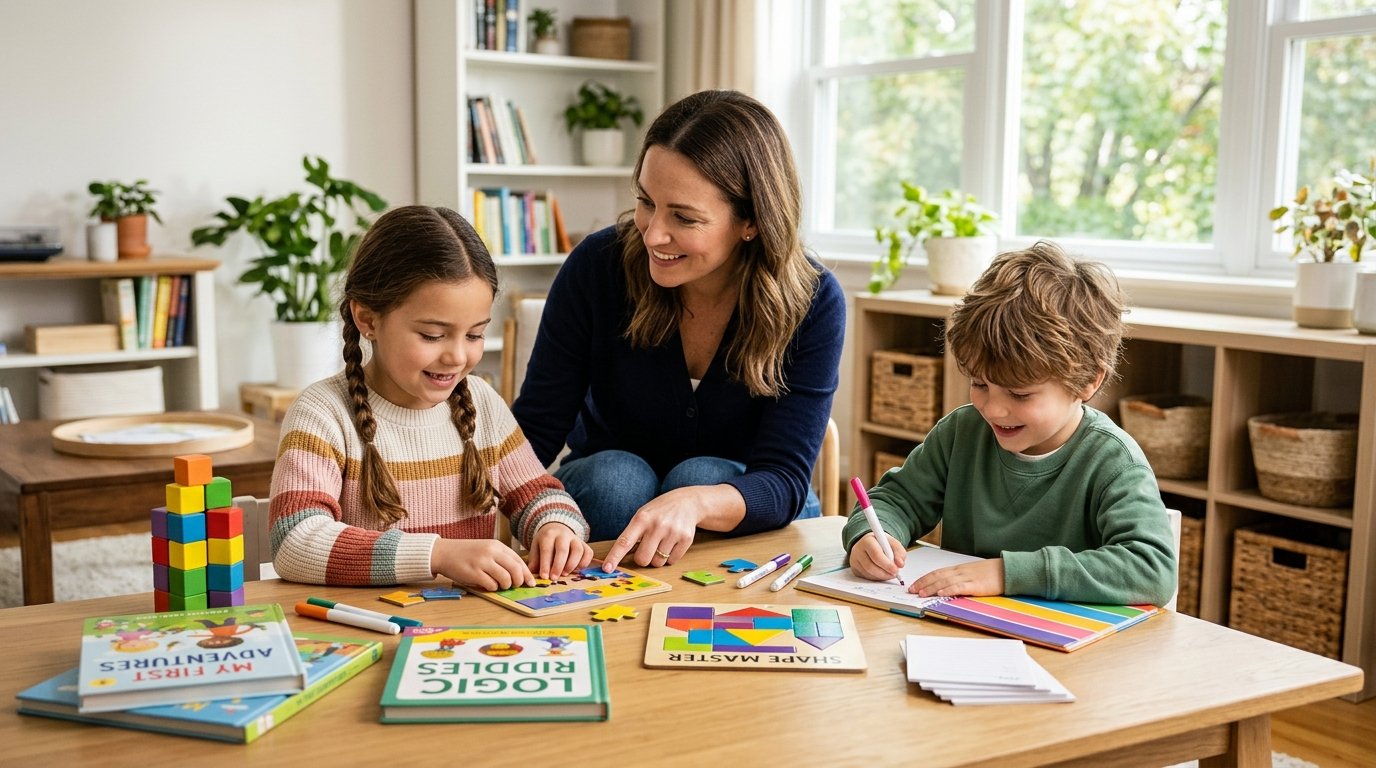
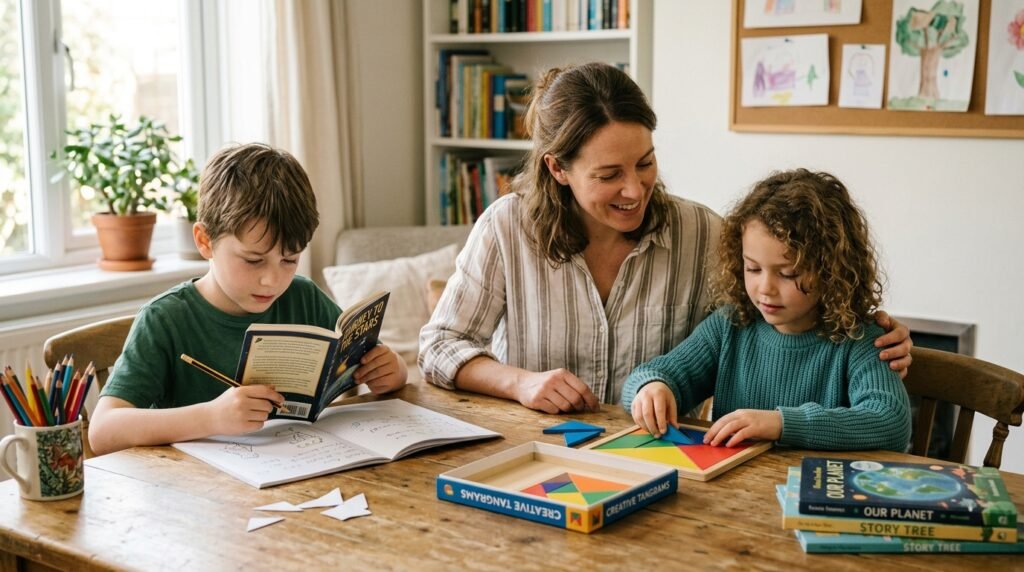
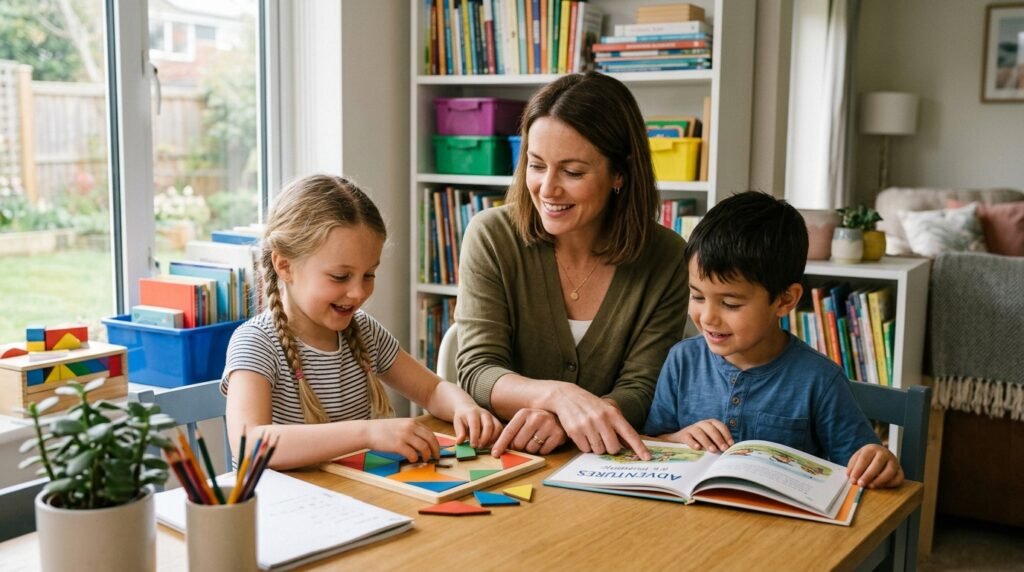
Reading together, storytelling, drawing, puzzles, building blocks, outdoor games, cooking, gardening, and simple household projects can all create opportunities for learning.
The LLBlogKids material specifically highlights play, reading, storytelling, puzzles, art, and outdoor activities as ways to support creativity, concentration, communication, and problem-solving.
This also fits UNICEF’s guidance for school-age children, which stresses learning through doing and encouraging activities beyond screens, including sports, music, and art.
The best activity is usually one that matches the child’s age and interests. A child who loves animals might enjoy reading animal books or creating a simple nature journal. A child who enjoys building could practice planning and problem-solving through blocks or basic construction activities.
Create Healthy Digital Habits
Modern child training also needs to include technology.
LLBlogKids recommends setting reasonable screen limits, monitoring online activities, choosing educational content, and teaching internet safety.
Current UNICEF guidance takes this further for school-age children. Parents are encouraged to understand the platforms children use, use parental controls when appropriate, teach online privacy, supervise digital activity, and talk openly about potentially unsafe online contact.
For younger children, screen exposure should be especially thoughtful. UNICEF’s 2026 guidance cites WHO recommendations of no sedentary screen time for children under 2 and no more than one hour per day for children ages 2 to 4, with less being better.
The bigger lesson is balance. Technology can support learning and connection, but it should not replace sleep, physical activity, conversation, play, or family interaction.
What Parents Should Avoid
Effective training is not only about what parents do. It is also about what they stop doing.
Comparing one child with another can create shame rather than motivation. UNICEF specifically advises parents of school-age children to avoid comparisons and focus on individual strengths and needs.
Harsh punishment, humiliation, threats, and violence should also be avoided. The AAP and UNICEF both emphasize nonviolent, constructive discipline instead.
Another common problem is inconsistency. When one behavior is allowed one day and punished the next, children receive mixed signals.
Clear expectations, calm repetition, and realistic consequences are usually easier for children to understand.
Is Training LLBlogKids a Formal Program?
There is an important distinction between the keyword and an established professional program.
LLBlogKids presents itself as an online parenting and child-development resource, and its current content covers training, education, play, routines, behavior, and life skills.
However, the available site information does not establish “Training LLBlogKids” as an independently validated therapeutic, educational, or clinical program. The phrase appears primarily in search-focused articles describing general parenting strategies.
That means parents should treat the website as one informational source rather than as a substitute for qualified professional advice. The CDC provides age-specific child-development resources, while pediatricians and qualified child-development professionals can provide individualized guidance when a child’s development or behavior raises concerns.
Frequently Asked Questions
What does training llblogkids mean?
The phrase is primarily used online for child-training and parenting guidance associated with LLBlogKids. It generally refers to teaching children positive habits, responsibility, communication, emotional skills, routines, and appropriate behavior rather than controlling them through harsh punishment.
When should child training begin?
Learning starts from early childhood through everyday interactions, modeling, routines, and communication. The type of training should change as the child develops. The CDC provides separate guidance for infants, toddlers, preschoolers, and older children because developmental abilities differ by age.
Is punishment necessary for good behavior?
Harsh punishment is not recommended. The AAP advises positive discipline that teaches children appropriate behavior, while UNICEF recommends calm guidance, boundaries, and nonviolent discipline.
How can parents make training easier?
Keep expectations clear, use consistent routines, demonstrate the behavior you want to see, give children age-appropriate responsibilities, and praise genuine effort and progress. Short, regular practice is often easier for children to handle than long periods of correction.
Conclusion
The most useful way to understand training llblogkids is as a search term surrounding practical child-training and positive parenting ideas rather than as a formally established program.
The most valuable principles are straightforward: understand developmental stages, create predictable routines, teach through everyday activities, encourage responsibility, name emotions, model respectful behavior, use positive discipline, and maintain sensible digital boundaries.
The strongest training does not aim to produce perfect children. It helps children gradually build the skills they need to make choices, manage emotions, communicate, cooperate, recover from mistakes, and become more independent.
That approach is also consistent with guidance from organizations such as the CDC, UNICEF, WHO, and the American Academy of Pediatrics.